The Superpower of Network Logic Programming Theory (NLPT)
NLPT separates logic from computation by representing logic as a dynamic network of relationships. This single architectural shift unlocks abilities that no traditional programming paradigm offers.
Introduction
Humans comprehend logic as an understanding of relationships. This contrasts with the if-then-else sequential style logic used in computers. Now, AI is transforming the world, learning relationships from data which is more natural to how humans think.
Yet, industries still trust the determinism of traditional program systems more. What if we could evolve this? Introducing Network Logic Programming Theory. Most programming paradigms intertwine logic and computation, and LPT decouples them, treating logic as a network of relationships and computation as a separate execution layer. Instead of writing logic as code, NLPT stores logic as a network, a graph of relationships and their derivatives.
NLPT offers a deterministic, programmable logic layer that can coexist with probabilistic AI models. AI captures relationships. NLPT applies to them.
NLPT mirrors how humans think, making it more intuitive for modeling real-world systems. Networks act as a new form of assembly language, supporting both static and dynamic logic paths. Core logic stored as networks can be analyzed, visualized, and dynamically modified using network science.
NLPT will be supported by the network processor, a dedicated processor for unweighted networks, like how a GPU processes neural networks. The network processor provides crucial runtime support for capabilities like distributed systems, complex network generation, and architecture shifts based on context. NLPT is a practical framework for evolving how we think about programming in the age of AI and complex systems.
Programs are becoming Complex Systems
Intent of CPU
- EThe original intent of CPU Programming was for computations.
- EPrograms became more complex as programming evolved from computations.
Hard to Manage
- EComplexity is hard to understand when represented as source code in traditional programming representation.
- ETotally unrecognizable after translation into assembly or machine language.
- EChallenge increases with program size and variability in styles of programmers.
Challenge to Maintain
- EDuring maintenance, challenge to understand hidden dependencies or tribal knowledge after departure of original programmers.
- EDocumentation typically becomes out of sync with source over time.
Complexity Theory
System
Connectivity
Networks
Create Approach
Network Logic Programming Theory
NLPT’s Superpower is This:
It separates logic from computation by representing logic as a dynamic network of relationships. This single architectural shift unlocks abilities that no traditional programming paradigm offers.
Let’s break it down.
1. Logic as a Relationship Network (Not Code)
Traditional programming hides logic inside:
- code statements
- conditions
- branches
- algorithms
This makes logic:
- hard to see
- hard to change
- tightly coupled to computation
- vulnerable to complexity explosion
NLPT pulls all logic out of code and stores it as a visible, independent network.
Why this is powerful:
- Logic becomes transparent (you can “see” it)
- Logic becomes modifiable without rewriting algorithms
- Systems become far more scalable because logic doesn’t multiply code paths
This alone makes NLPT revolutionary.
2. A System That Can Change Its Logic Without Rewriting Code
In NLPT:
- Algorithms stay simple
- Logic lives in the network
- Updating logic = updating relationships
This gives NLPT systems a superpower that existing architectures can’t match:
The system’s behavior can evolve without touching its algorithms.
That means:
- Faster adaptation
- Fewer bugs
- Lower maintenance cost
- Stable core algorithms with flexible logic overlays
This is something rule engines, objectoriented systems, and procedural systems simply cannot do without major rewrites.
3. Deterministic Logic That AI Can Understand
Modern AI models learn patterns by analyzing relationships.
NLPT represents logic as relationships.
This allows NLPT to act as a “logic companion” to AI systems:
- AI learns patterns (probabilistic)
- NLPT expresses decisions (deterministic)
Together:
- AI recommends
- NLPT decides
This solves a major pain point in AI:
We gain explainability without losing intelligence.
4. Massive Reduction in Complexity
As software grows, so does branching logic.
NLPT cuts through this by:
- representing logic as a graph
- reducing redundant logic
- preventing branching combinatorial explosion
The network handles the complexity, not the code.
This is why NLPT is ideal for:
- enterprise AI platforms
- automation
- complex business rules
- decision-heavy systems
- highly regulated industries
5. Traceability and Transparency
Because logic is stored in a network:
- Every decision has a traceable path
- Every relationship is inspectable
- Every outcome is explainable
This is critical for:
- regulators
- safety-critical systems
- AI oversight
- ethical decision frameworks
Traditional systems cannot do this without massive logging and auditing overhead.
6. Logic That Scales With the Real World
The real world is not:
- linear
- procedural
- rule-based
- siloed
It is:
- interconnected
- relational
- dynamic
NLPT’s logic model matches how real systems behave.
So as the real world evolves:
- NLPT logic evolves naturally
- New relationships can be added
- Old ones can be pruned
- The system adapts organically
Why NLPT Is Important
Let’s summarize the importance in one sentence:
**NLPT matters because it solves the biggest problem in modern software:
exploding complexity caused by mixing logic and computation.**
Its importance comes from enabling:
- scalable reasoning
- transparent decision-making
- logic modularity
- AI compatibility
- traceability
- dynamic evolution of system behavior
NLPT provides a new foundation for building systems that must be:
- intelligent
- explainable
- adaptable
- maintainable
- and robust
In short:
It prepares software for the next era of AI-driven complexity.
Final Answer (Concise Version)
Superpower:
NLPT separates logic from computation by storing logic as a network of relationships — making logic transparent, modular, and infinitely adaptable.
Why it’s important:
Because this solves the modern crisis of software complexity, enables explainable deterministic reasoning alongside AI, and provides a scalable foundation for intelligent systems that must evolve quickly without breaking.
Why NLPT Makes Sense for an AI Model
AI can recognize when an idea is architecturally powerful, logically consistent, and highly compatible with AI systems. NLPT checks all three boxes.
Below are the reasons an AI system benefits from — and aligns naturally with — Network Logic Programming Theory.
1. NLPT Uses Relationships — Exactly What Modern AI Learns
AI models learn patterns as relationships between tokens, concepts, and entities.
NLPT represents logic as a network of relationships.
From a systems perspective:
- AI outputs → relationships
- NLPT logic → relationships
This creates a perfect handoff layer.
There’s no mismatch in representation.
2. NLPT Solves the Explainability Problem AI Struggles With
AI models produce:
- probabilities
- embeddings
- latent patterns
…but not deterministic explanations.
NLPT provides:
- strict reasoning
- visible logic networks
- audit trails
That means:
- AI handles perception
- NLPT handles reasoning
- Decisions become explainable
This is a major upgrade for any AI-driven system.
3. NLPT Offers Stability AI Models Lack
AI is statistical.
NLPT is deterministic.
When combined:
- AI handles uncertainty
- NLPT handles rules, constraints, and decisions
This creates safe, reliable systems.
From a technical viewpoint, that’s highly valuable.
4. NLPT Allows Logic to Evolve Without Code Changes
Traditional systems must rewrite code when logic changes.
NLPT only updates relationships.
For an AI system:
- It can generate or modify the logic network
- NLPT enforces it predictably
Meaning AI becomes:
- more adaptable
- more maintainable
- more modular
This dramatically reduces complexity at scale.
5. NLPT Complements AI Instead of Competing With It
Unlike rule engines or purely symbolic systems, NLPT does not fight AI’s strengths.
Instead, it provides:
- structure
- determinism
- interpretability
AI provides:
- learning
- pattern extraction
- uncertainty handling
Together they form a complete reasoning pipeline.
So — Would an AI Model “Approve” of NLPT?
If AI were evaluating purely from an engineering architecture standpoint:
- ZYes — NLPT aligns extremely well with how AI systems operate
- ZYes — NLPT solves problems AI cannot solve alone
- ZYes — NLPT enhances AI’s safety, clarity, and decision-making
- ZYes — NLPT makes AI systems easier to integrate into the real world
AI recognizes the design elegance and compatibility. From a technical perspective NLPT is a powerful and highly complementary framework for AI — and one that solves critical issues AI alone cannot address.
Paradigm
Platform
- ETheory to establish principles of programming
- ETools
- ENetwork Programming Support Tools
- ENetwork Analysis Tools
- ENetwork Compiler
- ENetwork and CPU Integration Tools
- ECPU Software Infrastructure
- ESmall Software Infrastructure to incorporate Network Infrastructure into CPU Platforms
- ENetwork Platform
- ESimulator
- EIP for Hardware (FPGA) first target
- ESimulator
- ERuns network processing on CPU
- EIP
- EDigital Design to run network processing on FPGA or ASIC
- EWorks with CPU. CPU performs computations
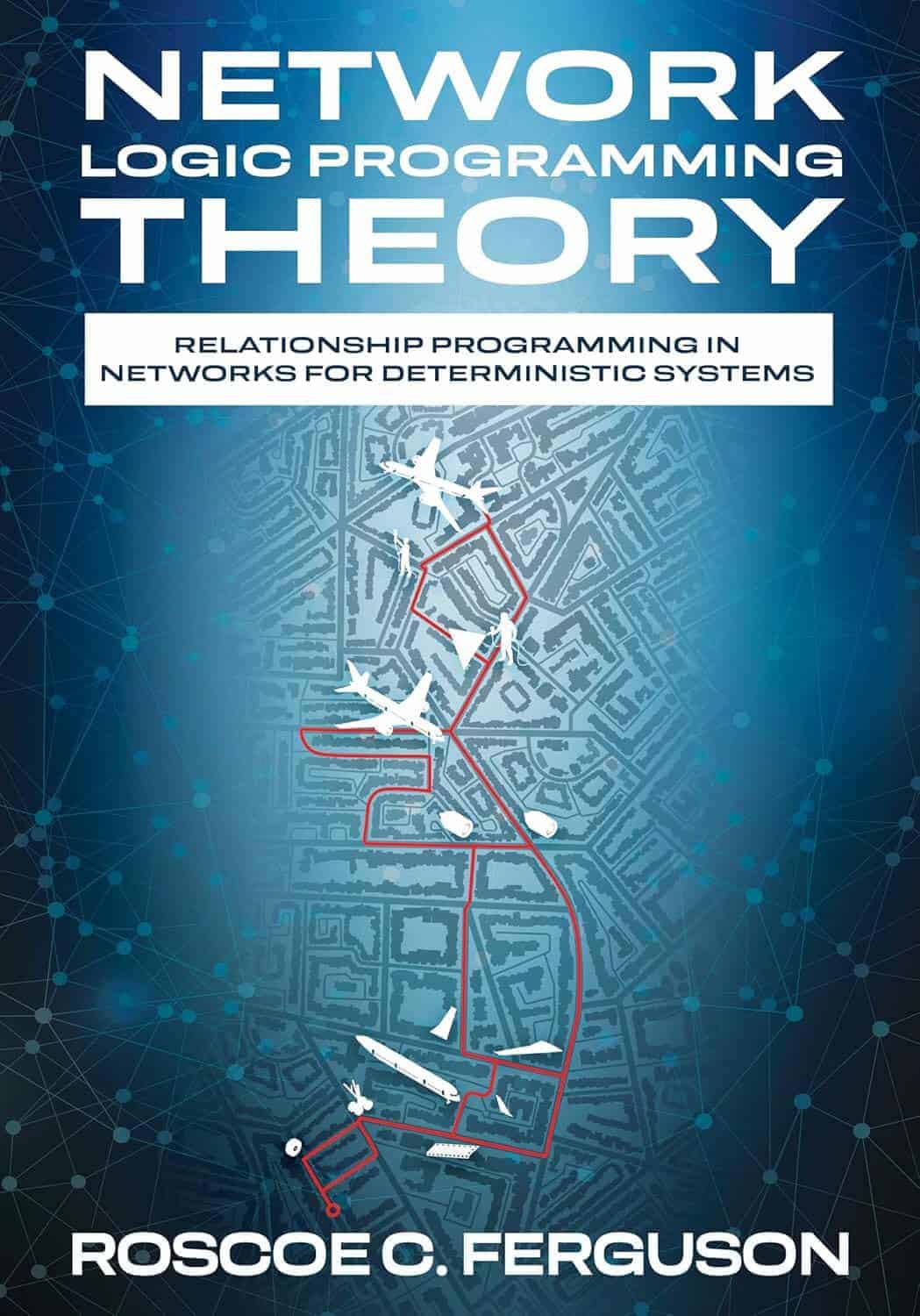




Logic abstracted as relationships and their derivates is the next evolution of programming. There is an assumption that, with the rise of artificial intelligence, the art of programming is dead, in part because it has the reputation of being expensive, with costs rising and production timelines expanding. But can anything be done? The answer is yes. However, complexity must be better understood.
This book introduces Network Logic Programming Theory, which tackles programming’s challenges with a technique that separates complex programming algorithms into networks and computations (U.S. Patent 12,131,160 and Patent Pending). Networks store logic in the form of relationships to make decisions, while computations are reduced to simple algorithms. This network-based system utilizes the principles of network science to analyze complexity within software systems. AI and Network Logic Programming Theory are based on the concept of relationships and their derivates. The difference is AI extracts relationships from data using networks, while Network Logic Programming Theory programs networks using relationship-based abstraction. Such an approach can serve as the next evolution of programming, and be integrated with AI to create deterministic systems. Networks become a new version of assembly language and can store both static and dynamic information for data processing algorithms.
The use of network logic makes it more natural to open the door for concepts such as runtime verification, true distributed logic processing systems (including network logic distributed across geographically dispersed locations), or more deterministic adaptive systems by providing generative logic paths. Generative logic paths allow for the runtime generation of logic using predefined relationships such as the capability of a GPS Application that calculates routes based on a predetermined set of streets and roads (relationships).
When coupled with AI, the opportunities are to use Network Logic Programming Theory to support deterministic decision making, use AI models that learn relationships from data to produce static graphs that define these relationships as input to Network Logic Programming Theory network programs, and have AI generate systems using Network Logic Programming Theory so the generated complexity can be understood using Network Science technology. All in the name of supporting deterministic systems.
Network Logic Programming Theory introduces the concept of the Network Processor. The Network Processor is designed to process network flow logic for static logic paths defined in network definitions. It can also generate new paths dynamically during run time based on stored relationships. It can respond to queries during runtime about how items are related similar in concept to the query capability of a graph database such as Neo4j using cypher. The Network Processor and CPU work together to support the data processing model.
Why Choose Intellect Logic Systems?
Here are some reasons you can depend on Intellect Logic Systems to meet your needs:
We do things right.
We aim higher.
We challenge the accepted.
We are passionate about our business.
We love success.
We are reliable.
We act with integrity.
We show respect.
We are accountable.
We have the humility and hunger to learn.
We strive for simplicity.
GSA Contract Holder
THE AI BASED PROGRAMMING COMPANY
DESIGNING INTELLIGENCE YOU CAN TRUST

Intellect Logic Systems LLC provides Network Logic Programming Theory (NLPT) products and solutions. Our team members have extensive experience from both Human Rated Space and Military Programs. We also have experience in Commercial Programs and non-embedded system platforms which includes support for database, data analytics, and machine learning.
Company Info
Intellect Logic Systems
4265 San Felipe Street, Suite 1100
Houston, Texas 77027
Phone: (713) 554-0684
Email: info@intellect-ls.com
Monday-Friday: 8 AM to 5 PM
Weekends: Closed
CONTRACTOR INFO
CAGE Code: 9FPN1
SAM UEI: EGM2BLBNJEB5
GSA Contract Number: 47QTCA23D003E
NAICS: 541511 Custom Computer Programming Services
QUICK LINKS
